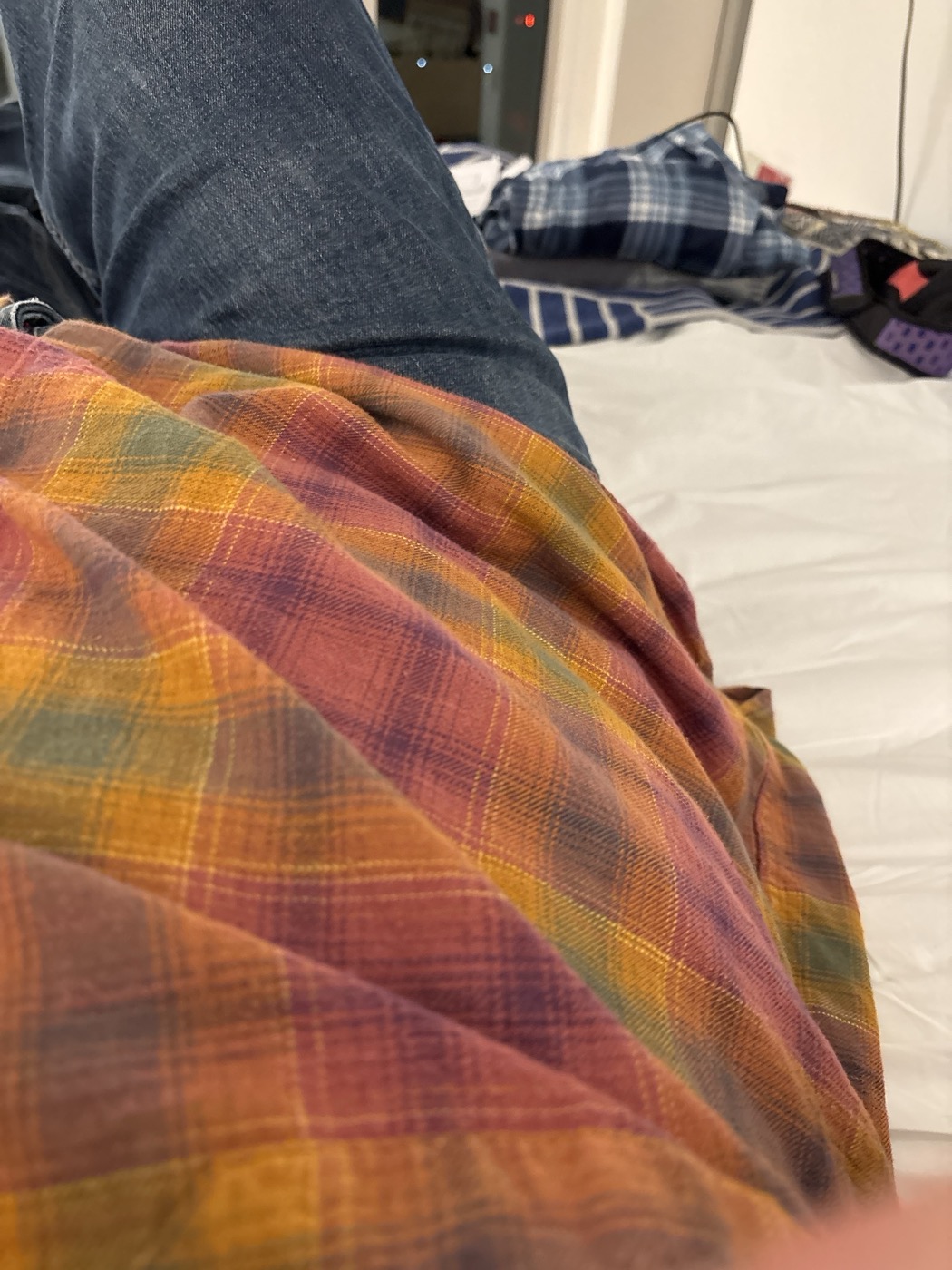
This is the happiest shirt I have ever owned. It is a Levi’s work shirt in a warm plaid that reads orange but is actually magenta, with ochre, sage green, plum and thin yellow lines running through it. It gives the impression that there’s just a lot going on. The cloth is a little bit heavy, and if it were me I would make it just a little bit heavier.
That’s actually a dream project, and it trumps anything I would think about doing in the rug or towel area. So this is the first step: a sample, to see whether I can get the colours.
The plan
I charted the plaid from the shirt and matched it to what was already on my shelf: seven colours of Venne cottolin 22/2. Cassis for the rose ground, Curry for the gold, Shamrock, Jaffa, Fawn, Brass, and three ends of Yellow. It is a 2/2 twill at 24 ends to the inch on my Louet Jane, the table loom. The weft follows the same colour order as the warp, which is what makes it square up into a plaid.
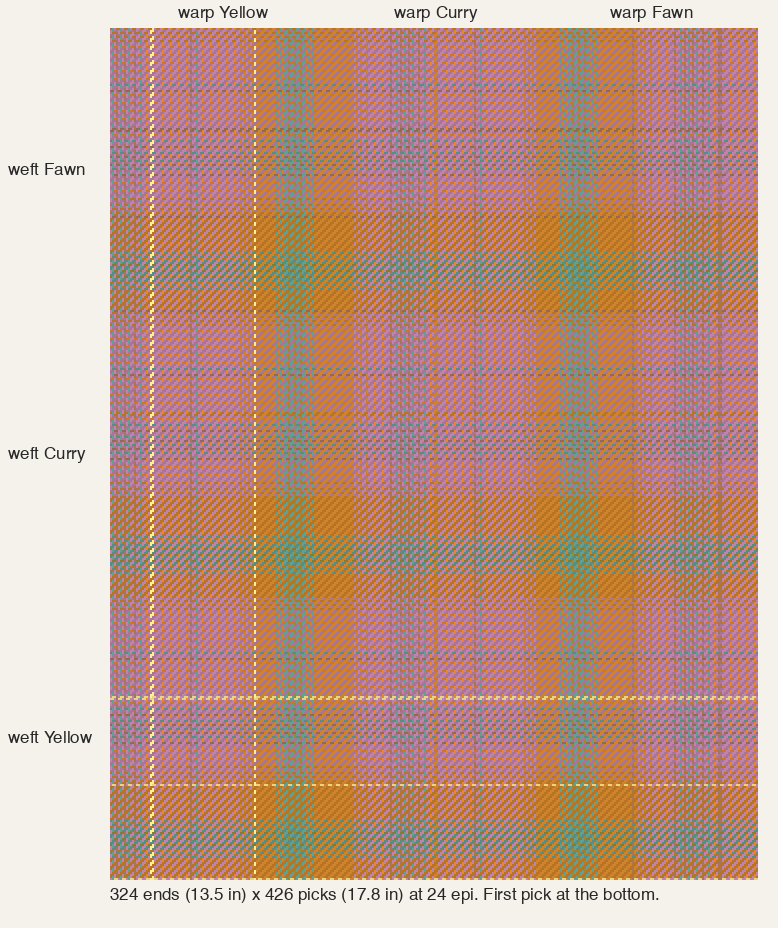
The bands in a plaid like this don’t stop, they fade. At the edge of each band the warp alternates the two colours end by end, Cassis with Curry, so one colour melts into the next. That is what a shadow plaid is, and it is where all the work is.
The warp
There are 182 colour changes in 324 ends. The tidy way to wind a colour-ordered warp is in exact end order, with a tie-off at every change, and I have done that before. It’s not practicable to tie them all off. So I wound seven chains, one per colour, and paid for it at the reed.
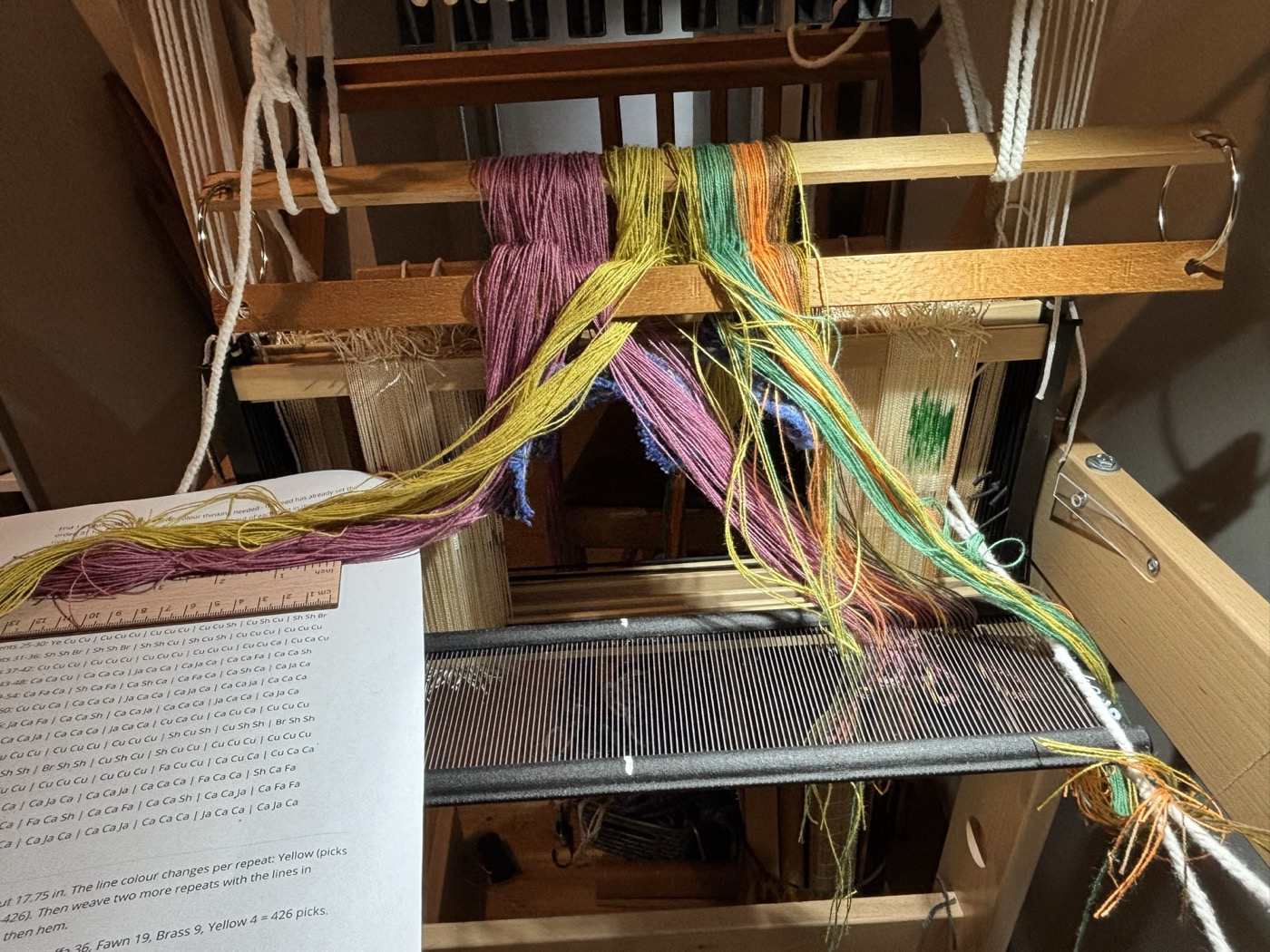
The problem with crossing over all these colours is that things get tangled. Cassis is in nearly every dent, so every Cassis end travels sideways across all the others to reach its place. I don’t think you can really straighten them out before beaming, and you don’t need to. Every crossing gets pushed to the tips when you wind on, and falls off.
Inside one colour the order doesn’t matter, because any Cassis end can go in any Cassis place. You are already messing the cross up so much. It would be a lot faster to just get it close.
Halfway across, I didn’t have enough ends of Curry. Can we just redesign with whatever we’ve got? We did, on the loom: dropped the missing Curry, shifted the last few dents along, and came out with 315 ends instead of 324. Then I was a Fawn short at the end of row 17. I came out with seven Cassis left over, which tells you where some of the Curry went.
Threading
Threading at 24 ends to the inch is hard for me. I did a few rows of plain weave to check, and found dents sleyed four, one, four, which leaves a gap. I pulled the ends out of the knots and out of the little bit of weaving and moved them, and repaired quite a lot. Everything else was threaded correctly. No doubling in this piece.
I notice that my craft is improving, because those sorts of things crop up later in the piece. I’m counting heddles now. If I do enough of these I’ll have all the detail covered that I need covered, but I am not there.
Weaving
The weft sequence is 426 picks with 236 colour runs. Most of them are a single pick. Colours that come back soon are carried up the edge, and the first list had me carrying some of them 24 picks. Twenty-five is crazy. The rule now is that a colour gets cut if it isn’t back within six picks.
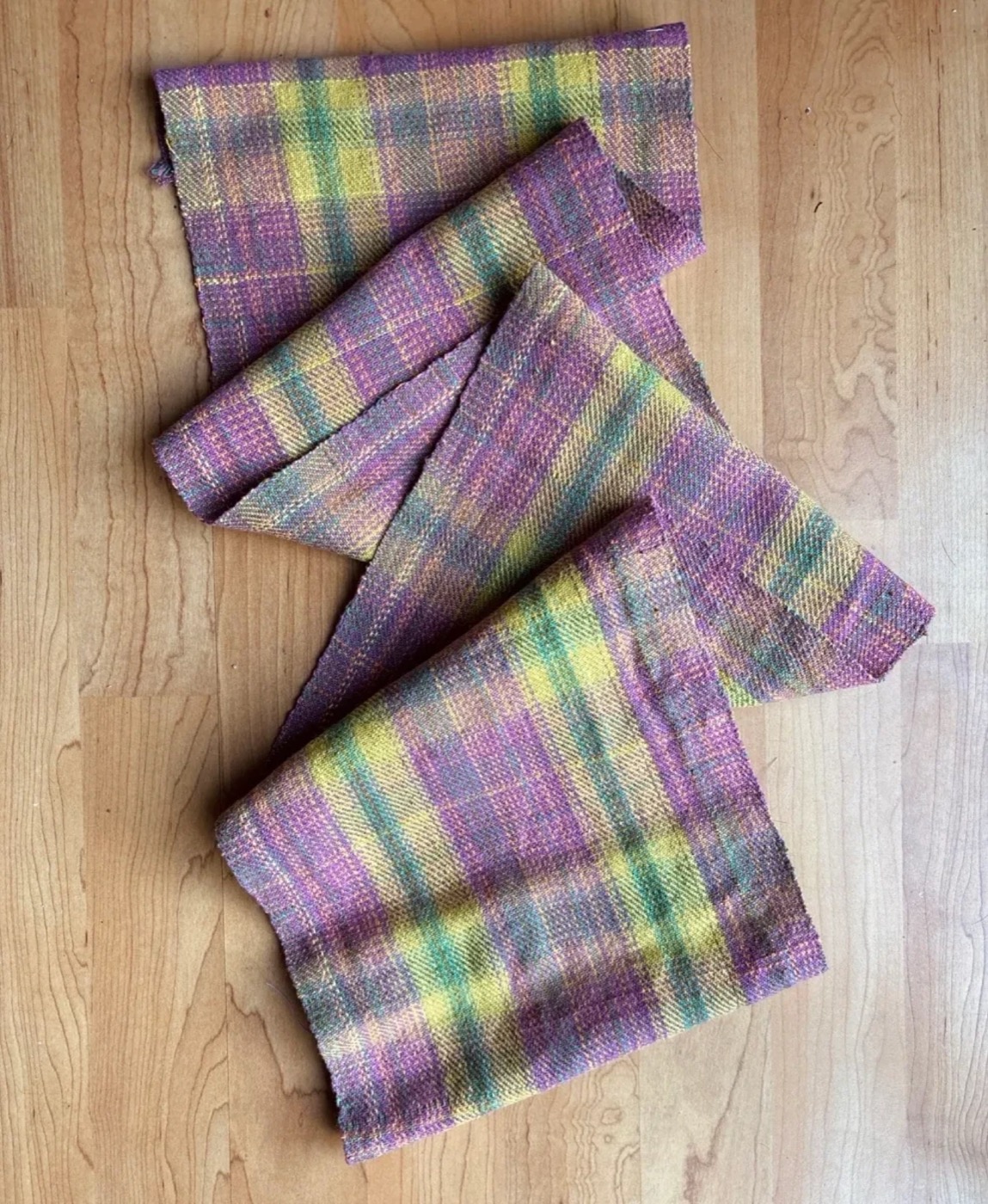
The first 426 picks were a test. The thin lines across the plaid were yellow in the first band, Curry in the second and Fawn in the third. Curry is the best, in my opinion. Yellow is a little too bright, and Fawn hardly shows at all.
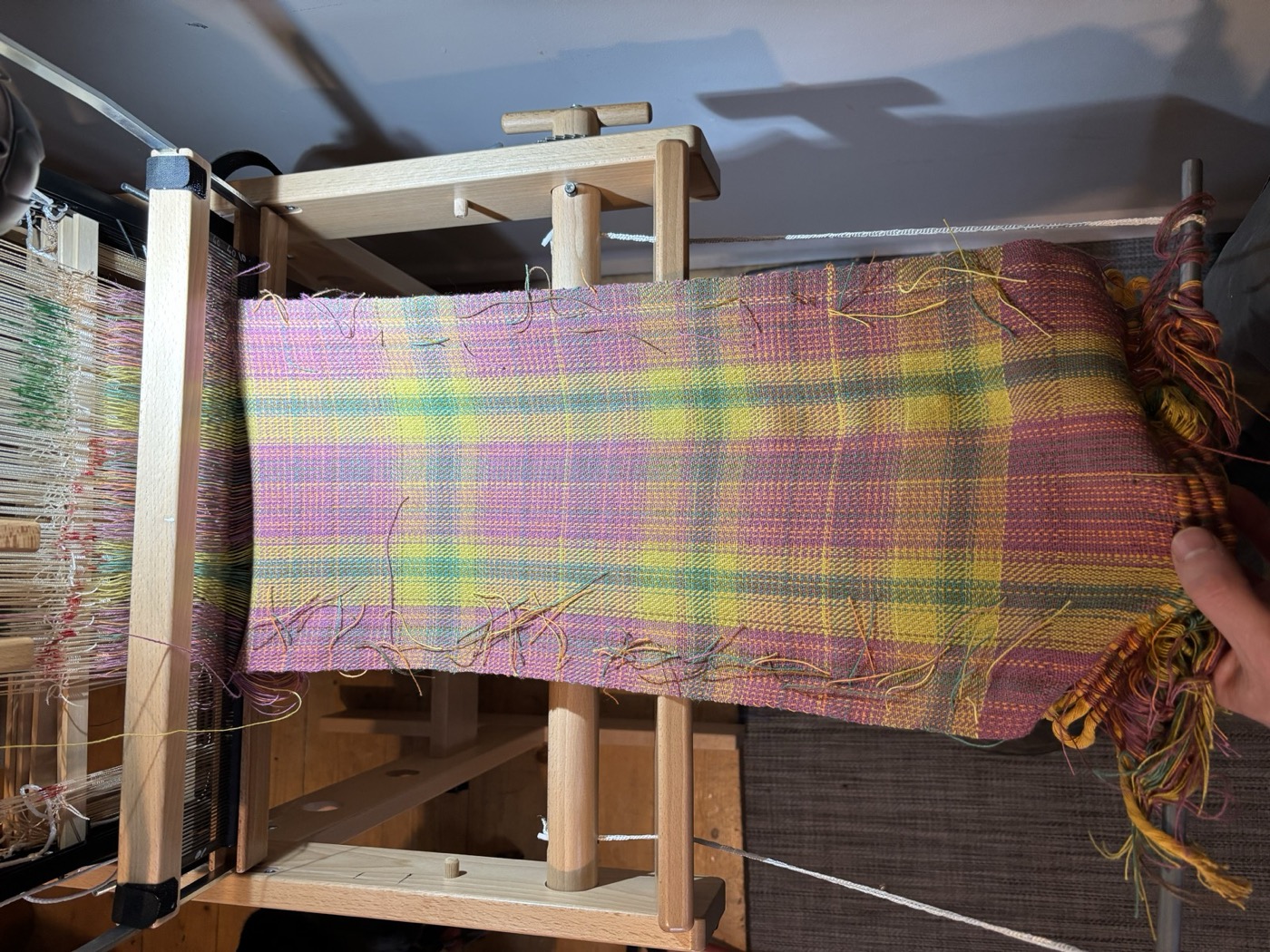
There are some carries that are a little longer than I’d like, and a few places where I forgot to weave the end in or had a loop. But overall it’s a fine piece, and I’m really happy with it.
Then it was a question of how far to go. It’s not reasonable to not just make as much as I can. So I ran the Curry repeat twice more and stopped when I thought the warp was nearly out. I have never run all the warp out, so I wasn’t sure how far the bar would go. Realistically I had another foot, I think. I’ll mark the loom for next time.
Off the loom
It came off at 49.5 inches hem to hem and washed down to 45. The square bits are pretty square. Jennifer thought it was interesting cloth, because it doesn’t stretch up or down but it stretches on the bias. And I’ve done a really good job on the selvedges.
What it becomes
I’m going to make a Merchant & Mills bucket hat from it. It’s the first time I have really wanted to make an object. There isn’t enough cloth for the whole hat, so the plaid goes on the crown and the brim will be plain. And then I can wear the bucket hat with the shirt.
The piece
| Yarn | Venne Bio Cottoline 22/2, seven colours from the shelf |
| Structure | 2/2 twill, straight draw, 4 shafts |
| Loom | Louet Jane table loom |
| Warp | 315 ends at 24 ends per inch, 2 m long |
| Weft | 426-pick test run, then the Curry-line repeat twice |
| Off the loom | 49.5 in hem to hem |
| Washed | 45 in long, about 9 in wide |
| Woven | Decided 22 October, warp wound 23 October, sleyed 24 October, tied on 29 October, off the loom 10 November, washed 11 November 2026 |